A good sampling of the birds of several coastal habitats occurs in Santa Cruz’s southwest corner, and the area also boasts some of the county’s better “vagrant traps.” Natural Bridges is one of the county’s most popular birding sites, with a history of rare birds. This park has a picnic area and nature center but no camping. Cars are charged an entrance fee, but you may park outside and walk in for free.
Directions.
The main entrance to Natural Bridges is at the west end of West Cliff Dr, adjacent to its intersection with Swanton Blvd. Parking on Swanton Blvd is free, and there is a short-term, free parking lot inside the park just before the entrance station. One may walk in for free at the north side of the park from Delaware Ave at the foot of Natural Bridges Dr. Park trails are also accessible across Delaware Ave from Antonelli Pond.
Birds.
Beach and Rocky Shoreline
The beach at Natural Bridges – attractive to gulls and shorebirds – is best early in the morning before too many people arrive. At the west end of the beach, Moore Creek seasonally forms a lagoon, which can be good for a heron or two or sometimes an interesting shorebird in the spring or fall. The rocky shoreline west of the beach often has rock-favoring shorebirds, such as resident Black Oystercatcher, migrating Wandering Tattler, and wintering Black Turnstone, Surfbird, and Whimbrel.
The parking lot on the bluff near the West Cliff Dr entrance provides a vantage point from which to scan the beach or to scope the ocean. Loons, grebes, shearwaters, scoters, and Red-breasted Merganser can be seen in winter. Common Murre are year round and Pigeon Guillemot breed in crevices on the cliffs. Additionally Marbled Murrelet are sometimes seen. The natural bridge (the last remaining of three) adjacent to this parking lot is a resting place for gulls, Brown Pelican and Cormorants. Here you can compare Brandt’s, Double-crested and Pelagic cormorants. Western Gull and Brandt’s Cormorant have nested on the natural bridge and on the cliffs east of the bluff parking lot.
Inland Areas
The inland parts of the park include willow thickets, coastal scrub, and groves of pine and eucalyptus trees. These areas have produced a host of rare landbirds (e.g., Grace’s Warbler, Painted Bunting, and Dusky-capped Flycatcher). Many birders start at the wooden walkway that leads from park headquarters to the “Butterfly Trees” famed for wintering monarch butterflies (peak numbers occur from October to February).
The Boardwalk and pond
This path enters a eucalyptus-filled drainage with an understory of blackberries and poison oak. Swainson’s Thrush and Western Flycatcher are among the nesters here; in the fall the berry tangles attract migrant Western Tanager, Black-headed Grosbeak, Swainson’s and Hermit thrushes, and others. Near the lower end of the walkway a dirt trail leads to the right, past a seasonal pond. Check the willows and the margin of the pond for various landbirds; Green Heron and Black-crowned Night-Heron are frequently here when there is water. The willows south of the pond and along the adjacent park entrance road should be checked thoroughly for migrant and vagrant landbirds.
East side trail
The trail climbs east past the willows and turns north into an open area with Monterey pines on the east side of the park. The habitat here is changing; many of the pines have died from pitch canker, although some still appear healthy. A variety of forest birds occur here, and the dead pines provide nesting habitat for woodpeckers, Pygmy Nuthatch, Violet-green Swallow and others. The mixed flocks that forage through the trees occasionally include unusual warblers and other species. Golden-crowned Kinglets forage here in the fall and winter; flocks of swallows and swifts ply the air in spring and summer. Near Delaware Ave the trail dips west and passes among willows and eucalyptus in the upper end of the “Butterfly Trees” drainage. Search carefully here for migrant and wintering birds.
West side trail
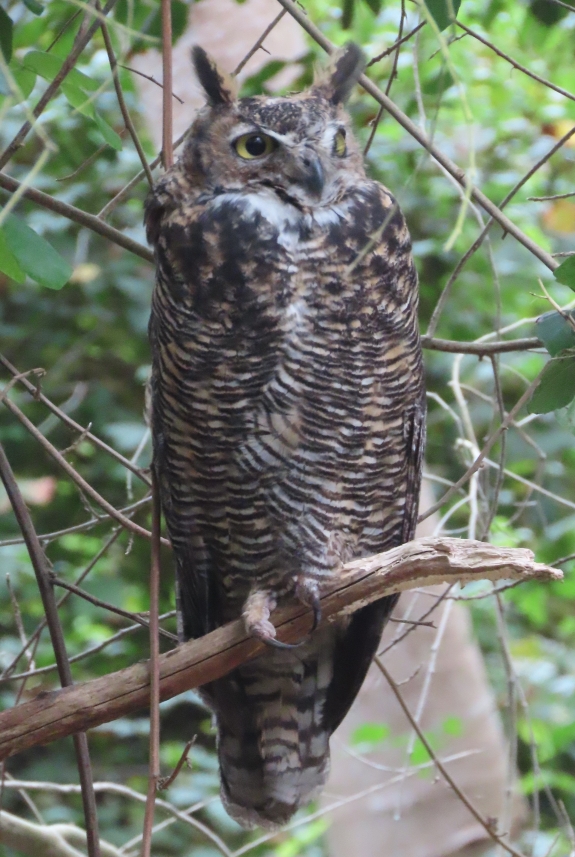
Great Horned Owls reside in the grove. Once past the north entrance road, the trail continues west alongside an open area of scrub, grass, and scattered pines, then descends coastward to Moore Creek. This open area is good for seed-eaters and scrub specialists. Look for House Wren and Blue-gray Gnatcatcher in the fall and winter.
As you approach tall eucalyptus trees, the trail turns left and descends to the marshy bottomland of the lowest reach of Moore Creek. (A right turn at the trees goes to Delaware Ave and Antonelli Pond.) The wetland as you approach the mouth of Moore Creek harbors sparrows and Common Yellowthroat. Lincoln’s Sparrow is fairly common here in fall and winter, and White-throated and Swamp sparrows may also be present then. The surrounding willow and scrub thickets harbor migrants, Wrentit, American Goldfinch, wintering House Wren, and riparian breeding species such as Swainson’s Thrush and Wilson’s Warbler. Hooded Orioles lurk in these and other willow thickets in the park, especially in late summer.
The are behind the visitors center has a grove of euacalyptus trees which is where Great-Horned Owls have often nested in recent years.